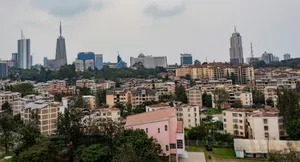


Westlands looks, on the surface, like any other busy Nairobi suburb: office towers, malls, traffic on Waiyaki Way, a dense strip of restaurants and bars that fills up on Friday nights. What's harder to see from street level is the machinery underneath it, the actual channels through which global capital, diplomatic investment, remittances, and a rising consumer class convert into the buildings, jobs, and spending that define the area. Pull on each of those threads individually and a clearer picture emerges: Westlands isn't just a nice place to be based. It is where several of Kenya's biggest economic currents physically converge.
1. Global Capital Has a Postcode
Kenyan startups raised $114.5 million in the first quarter of 2026 alone, across seven disclosed deals, according to funding data compiled by Condia and reported through TechCabal Insights. That placed Kenya third among African markets for the quarter, behind Egypt and South Africa, and the two anchor deals tell their own story: Sistema.bio's $53 million growth round for off-grid biogas systems, and Zeno's $25 million Series A in electric motorcycles. Both are exactly the kind of infrastructure-adjacent, asset-heavy businesses that need real office space, logistics coordination, and investor meetings, not just a laptop and a coffee shop.
That capital has a physical address more often than not, and increasingly, that address is Westlands. The neighborhood hosts Nairobi Garage, the largest co-working network in Africa with multiple locations concentrated in the area, alongside KOFISI's Westlands campus, The Mint Hub, iHub, and a dense cluster of smaller creative and tech-focused spaces. Microsoft didn't choose a Nairobi suburb at random when it opened a $27 million engineering hub and Microsoft Garage incubation space at Dunhill Towers. Google made the same call with its Africa Development Centre. When global capital lands in Kenya, it overwhelmingly lands, works, and meets in Westlands first.
2. Open Borders Turned Nairobi Into a Waiting Room With Wi-Fi
Kenya's visa policy has changed twice in under two years, and each change pushed more short-term professional traffic through the city. From January 2024, foreign nationals of any origin could enter visa-free, replaced instead by an Electronic Travel Authorization. Then, in July 2025, Kenya went further, scrapping the ETA requirement entirely for nearly every African nation, allowing entry with nothing more than a passport, no forms, no $30 fee, no waiting period. East African Community nationals now get up to six months' stay; most other African visitors get 60 to 90 days.
The practical effect is a steady flow of consultants, founders, investors, and mid-career professionals who land in Nairobi to scout, meet, and test the market before committing to anything longer-term. Westlands is where that scouting happens. It has the highest concentration of serviced apartments, business hotels, and co-working memberships built for exactly this kind of short-stay professional, and every week one of them spends in the area, on food, transport, meeting-room rentals, and short leases, adds to a layer of spending that never shows up in a single year-end statistic but compounds constantly.
3. The Remittance Economy Runs Through Local Spend
Kenya's diaspora is now the country's single largest source of foreign exchange, ahead of tourism and agricultural exports combined. The Central Bank of Kenya's current 2026 projection sits at $5.1 billion, a figure that itself tells a more interesting story than the headline number suggests: CBK started the year forecasting $5.42 billion, a 6 percent increase, before cutting that projection by roughly $313 million once Gulf-corridor remittances slowed on the back of the Iran conflict and new Saudi transaction taxes. Even with that downgrade, March 2026 alone brought in a record $450.3 million in a single month, the highest ever recorded.
That money doesn't sit in savings accounts. It pays school fees, funds small business ventures, and increasingly, according to Kenya's 2025 Remittances Household Survey, gets channelled into property investment and day-to-day consumption. Westlands, with its concentration of premium retail, dining, and services, absorbs a disproportionate share of that discretionary spend simply because it's where Nairobi's growing base of remittance-supported households and returnee entrepreneurs choose to spend it.
4. Population Growth Is Concentrating at the Top
Nairobi's metro population has grown at just over 4 percent annually for most of the last five years, reaching an estimated 5.6 to 6 million residents in 2026, among the fastest urban growth rates on the continent. What the aggregate number hides is where that growth is landing economically. A large share of the city's expansion is absorbed into informal settlements, but the higher-income slice of that growth, returning diaspora, relocating professionals, growing families with rising incomes, is landing disproportionately in a small number of established, well-serviced neighborhoods. Westlands, with its schools, hospitals, and zoning changes that have permitted a wave of new luxury apartment towers, is one of the clearest beneficiaries of that upward sorting. More higher-income households in a fixed geography means more restaurant covers, more retail transactions, and more services demand per square kilometer than almost anywhere else in the city.
5. The UN Effect Is the Single Largest Anchor Investment in the Area's History
In May 2026, UN Secretary-General António Guterres and President William Ruto broke ground on a $340 million expansion of the UN's Gigiri complex, the largest non-peacekeeping investment the UN Secretariat has made anywhere in Africa since its founding. The project splits into a $66.2 million office and upgrade programme, already delivering six new climate-resilient, net-zero buildings to replace the original 1970s structures, and a $265.6 million conference facility overhaul that will lift UNON's meeting capacity from 2,000 to 9,000 delegates by 2030, including a new 1,600-seat assembly hall. Once complete, Nairobi becomes only the third UN campus in the world, after New York and Geneva, with conference infrastructure at that scale.
The Gigiri complex already hosts more than 70 UN offices and over 4,000 staff. An expansion of this size doesn't stay contained behind UN gates. Real estate analysts have already flagged the ripple effect it's creating for Grade A office space, co-working demand, and diplomatic-standard housing across Gigiri, Limuru Road, and Westlands specifically, with retail centers like Village Market and Rosslyn Riviera Mall positioned as direct beneficiaries of the growing expatriate and diplomatic footfall this investment guarantees for the next decade.
6. Real Estate Value Concentrates Where the Money Already Is
Westlands was Nairobi's best-performing commercial office node as of the most recent full-year data, posting average rental yields of 8.5 percent against a Nairobi Metropolitan Area average of 7.7 percent, according to Cytonn Investments' commercial office research. Residential apartment yields in the area have run even higher, reaching above 10 percent in early 2025 on strong occupancy from a well-heeled tenant base. That combination, prime multinational tenants willing to pay rent in dollars and premium residential demand from professionals and expatriates, is precisely what has driven developers to build aggressively in the area over the past several years.
That building wave has produced its own honest complication: Westlands saw apartment sale prices correct by more than 11 percent through 2025 as new supply outpaced absorption in the short term. Rather than undercutting the thesis, that correction is itself evidence of how much capital has already poured into the area, more than the market could immediately absorb in one cycle. Rental yields, the more reliable long-run signal of underlying demand, have stayed resilient through the same period.
7. Events and Experiences Are Where Discretionary Money Actually Lands
Kenya's consumer spending, like much of the world's, has been shifting from goods toward experiences, and nowhere in Nairobi is that shift more visible than in Westlands. The neighborhood has become, by most current accounts, the undisputed center of the city's nightlife, with its dense cluster of rooftop lounges, live music venues, and restaurants along streets like Woodvale Grove, Mwanzi Road, and Parklands Road pulling weekend crowds that used to gather in the CBD a decade ago. Venues like K1 Klub House, B-Club, Sarabi Rooftop Lounge, and Brew Bistro anchor a strip that, by several current nightlife guides' estimates, now represents Nairobi's single densest concentration of bars, clubs, and entertainment spending in one walkable radius. Every one of those covers, every bottle service table, every rooftop reservation is discretionary money that, a decade ago, might have gone toward a physical purchase instead. Now it goes toward an evening in Westlands.
8. Digital Infrastructure Is Where the Next Wave of Growth Sits
Kenya's Gen Z and millennial consumers are genuinely tech-native, and the country's mobile money infrastructure, the system that made this possible in the first place, is headquartered squarely inside Westlands, at Safaricom House. M-Pesa didn't just start in Kenya, it effectively runs its national nerve center from this neighborhood, and the broader fintech, e-commerce, and consumer tech ecosystem that has grown up around mobile money continues to cluster nearby, drawn by the same co-working infrastructure and talent pool already discussed. As younger, digitally fluent consumers become a larger share of Nairobi's spending population, the businesses built to serve them, delivery platforms, digital-first retail, subscription services, are choosing Westlands as their base for the same reasons the capital already flowing into the area chose it first.
9. The Corporate Anchor Effect
None of the above happens without the area's original economic engine: the sheer concentration of multinational corporate headquarters that made Westlands Nairobi's default answer to "where does a serious company go." Standard Chartered Bank, Microsoft, BMW's regional assembly and distribution operation, and Coca-Cola's local operations all sit inside Westlands, alongside Safaricom, joining a shift that Jones Lang LaSalle first documented years ago: as Nairobi's central business district ran out of modern, efficient office space, decentralized nodes like Westlands absorbed the overflow and never gave it back. Every one of those corporate anchors brings hundreds of salaried employees who eat lunch, take client meetings, and spend evenings within a few kilometers of their office, which is the quiet, compounding foundation everything else on this list is ultimately built on top of.
The Thesis, Stated Plainly
Money doesn't move through Westlands by accident. It moves there because five or six independent, verifiable forces, venture capital, diplomatic investment, remittance flows, migration patterns, corporate real estate decisions, and a changing consumer culture, all happen to be pointing at the same four square kilometers at the same time. Any one of these alone would make Westlands an interesting neighborhood. Together, they make it the clearest physical evidence available of where Kenya's economy is actually headed next.