


Octavia Carbon, the Global South’s first direct air capture company, believes Kenya is the best place on earth to pull carbon dioxide out of the air. CEO Martin Freimüller, an Austrian who has lived in Kenya for four and a half years, says the case comes down to three things: energy, geology and talent.
Hear it from Martin Freimüller himself. The full conversation was recorded at Octavia’s manufacturing plant outside Nairobi.
Martin Freimüller, CEO of Octavia Carbon, on the Voices and Visions podcast. Produced by Tutapasa Agency.
Why Kenya works for carbon removal
Direct air capture runs air through a filter, then releases the trapped CO2, which takes a lot of energy. Freimüller says Kenya’s grid is more than 90 per cent renewable, and the parts of central Kenya where Octavia builds are fully renewable, much of it geothermal. More than 80 per cent of the energy in the machines is heat, which geothermal supplies cheaply.
Storage is the second piece. Octavia’s partner, Cella Mineral Storage, injects the CO2 about 1,000 metres underground into basalt, a porous volcanic rock common along the Rift Valley. There it reacts with minerals and turns into stone within months to a few years.
Freimüller also points to Kenya’s engineers, who he says can be hired at a fraction of Silicon Valley or Swiss costs.


Built on customer money, not grants
Octavia started at a kitchen table in 2022, with co-founder Duncan Kariuki, a mechanical engineer who began working on direct air capture as a University of Nairobi project. Investors, Freimüller says, thought they were crazy to build deep tech in Kenya.
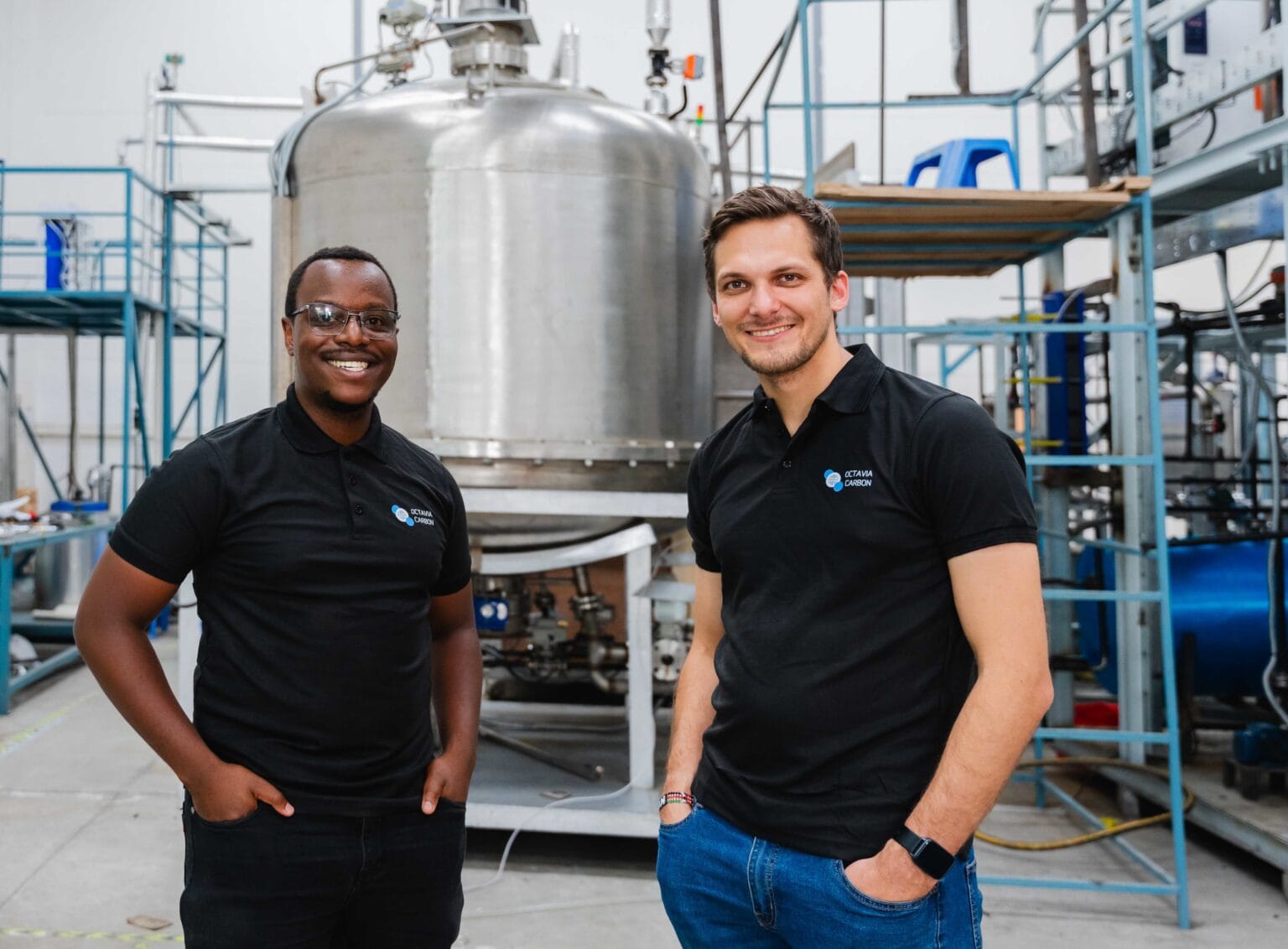
Early cash came from angels and the Catalyst Fund accelerator. Then buyers stepped in, including Milkywire’s climate fund, with large prepayments for future carbon credits. Before its seed round, Octavia had taken $1.2 million from customers against $1.1 million in pre-seed equity.

Of roughly $10 million raised so far, he says only about $100,000 was grant money. Family offices and wealthy individuals make up much of the rest, mostly from Europe and the US.
So, what's next
Octavia now employs about 70 people, most under 30, and says its team is 99 per cent Kenyan. It works with the University of Nairobi, Jomo Kenyatta University of Agriculture and Technology and Strathmore University.
Freimüller’s targets are removing hundreds of thousands to millions of tonnes of CO2 in ten years, and billions in twenty, with costs under $100 a tonne. He says carbon removal should not slow emissions cuts elsewhere. It is meant for hard-to-abate sectors like aviation.

