The story of Nairobi's rise as a global city

Stay tuned

Don’t miss out on the latest issues. Sign up now to get access to the library of members-only issues.

jamie@example.com

Inside China's Bid to Build Its African Headquarters in Nairobi

Inside China's Bid to Build Its African Headquarters in Nairobi

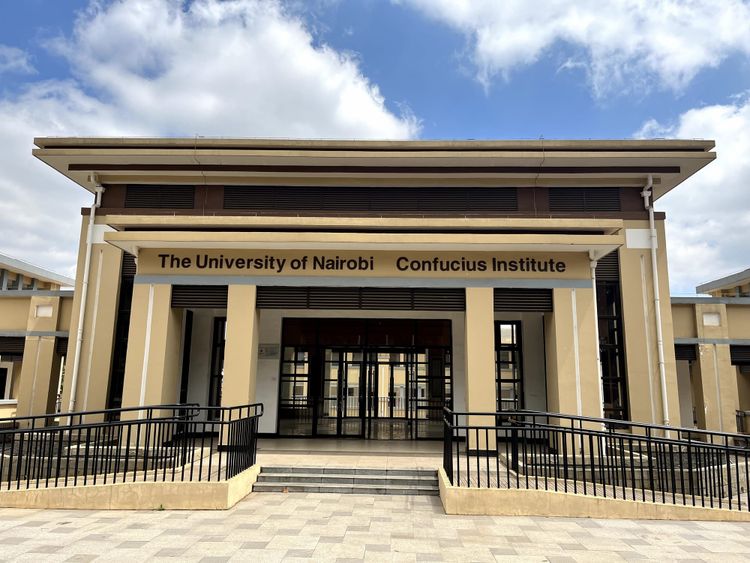
On Arboretum Drive, a few minutes from the University of Nairobi's main campus, sits a $20 million complex built with lecture halls, language labs, a hostel wing, and conference facilities. When it was completed and handed over in 2019, in a ceremony attended by Kenya's then-Cabinet Secretary for Education, it wasn't described in local reporting as just another university building. It was described, in coverage at the time, as China's African headquarters for its global Confucius Institute programme, and the story of how it got that title says a great deal about where Nairobi sits in China's broader strategy on the continent.

Africa's First, and Still Its Flagship

The Confucius Institute at the University of Nairobi holds a genuine distinction: it was the first Confucius Institute established anywhere in Africa, opening its doors on December 19, 2005. Chinese President Hu Jintao personally visited the institute during a 2006 trip to Kenya, an early signal of how much diplomatic weight Beijing was placing on the project from the start.

Two decades on, the institute has become one of the programme's most decorated branches worldwide, winning the "Confucius Institute of the Year" award seven times and earning "Global Model Confucius Institute" recognition, a status held by only a small fraction of the roughly 500-plus Confucius Institutes operating globally. It remains the only institution in Kenya offering Chinese language as a full, standalone Bachelor of Arts degree, with a scholarship pipeline that regularly sends top students to Tianjin Normal University, its Chinese partner institution, for fully funded study.

From One Building to a Continental Network

What makes Nairobi's role distinct isn't just its seniority, it's the scale that grew around it. By 2019, China had expanded the Confucius Institute programme to 71 institutes and language classrooms across Africa, with further expansion planned. Nairobi's branch, as the continent's original outpost and its most consistently awarded, has functioned as the network's reference point for the region ever since, the institution other African branches are effectively modeled against.

The Arboretum Drive complex itself was purpose-built for that role. The agreement establishing it was signed in 2016, and the finished building was explicitly designed with the housing, conference, and administrative capacity to support activity well beyond a single university's needs, exactly the kind of infrastructure a regional coordinating hub would require rather than a standard campus language center.

The Money Behind the Language Classes

The institute's ties to China's economic footprint in Kenya are a matter of public record, not speculation. Its own published activity reports describe students and cultural groups performing for workers on the Mombasa-Nairobi Standard Gauge Railway, and a farewell event held for a special envoy of President Xi Jinping during the SGR's construction kickoff. Its graduates have gone on to positions with Chinese state-linked companies operating in Kenya, including China Road and Bridge Corporation, PetroChina, and China Electric Construction, firms central to Kenya's Belt and Road-era infrastructure boom.

The institute has also pushed Mandarin instruction beyond university walls, working with Kenya's Institute of Curriculum Development on a programme introducing Chinese as a selective language option in primary and secondary schools, formalized through a memorandum of understanding with the university's Faculty of Arts. None of this is hidden. It's published on the institute's own site as evidence of its impact and reach.

Why Scholars Are Still Debating the Real Purpose

None of this scale is inherently sinister, and Confucius Institutes exist to teach language and culture, which is genuinely what happens inside them every day. But the institute's role has also made it a specific subject of academic scrutiny. A widely cited study focused specifically on the University of Nairobi branch found that while Kenyan policymakers hoped it would produce Mandarin-speaking professionals able to work more easily with Chinese firms on the ground, Chinese administrators involved with the institute appeared more focused on protecting China's image than on open, two-way cultural exchange, a tension researchers have traced back to the broader soft power theory the Confucius Institute model was built on.

That tension isn't unique to Nairobi. Confucius Institutes worldwide have faced the same underlying criticism, that they function as instruments of Chinese state messaging on university campuses rather than neutral cultural exchanges, concerns serious enough that the United States formally designated its Confucius Institutes as "foreign missions" in 2020, that a former US Secretary of State called for all of them to close, and that Sweden shut down every Confucius Institute operating in the country entirely. Nairobi's institute has faced none of that kind of formal pushback, and remains, by every available measure, one of the programme's most successful and most heavily invested-in branches anywhere in the world.

What the Evidence Actually Points To

Strip away the speculation and what remains is still a striking picture: a two-decade relationship that started with a single classroom and grew, deliberately and with sustained high-level backing from Beijing, into a $20 million complex explicitly built to anchor China's cultural and educational strategy for an entire continent. Whether that investment is best understood as generous cultural diplomacy, savvy economic groundwork for Belt and Road-era business ties, or a genuine instrument of political influence is a live and legitimate debate among the scholars who study it closely. What isn't in dispute is where China chose to place its bet first, and biggest: Nairobi.


Sources

  • University of Nairobi, Confucius Institute official pages and activity archive
  • The PIE News, "China stamps mark on Africa with $20m investment" (2019)
  • China Daily, "Confucius Institute at the University of Nairobi marks the Year of Dragon celebrations" (2024)
  • Wheeler, A., "Cultural Diplomacy, Language Planning, and the Case of the University of Nairobi Confucius Institute," Journal of Asian and African Studies (2014)
  • Li, S., "A Foucauldian Power Analysis of China's Confucius Institute in Africa," 2023
  • Lee Kuan Yew School of Public Policy, National University of Singapore, "Confucius Institute backlash reveals bigger problems with China's soft power" (2021)
Latest issue